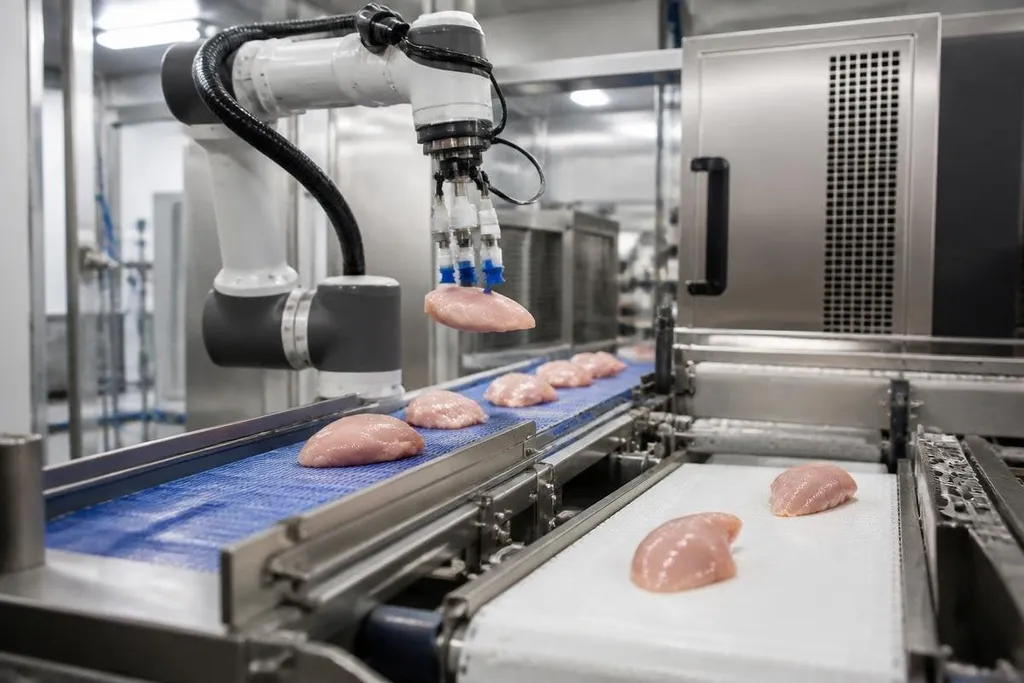
A food robot can pick a product at high speed and still fail at the last 10 cm. The hard part is moving soft, wet, uneven items from one process to the next without damage or long stops.
That makes the global race easier to judge. Look past the arm, camera, or gripper and ask how the full line performs when food shape, temperature, moisture, and cleaning all change.
- The real test: consistent handling across changing food items
- The hidden cost: cleaning, changeovers, rejected products, and stopped lines
- The proof needed: logged production runs, not a short staged pick
Why food is a hard robot task
Factory parts tend to keep their shape. Food does not. A tomato can vary in size, a piece of dough can stretch, and a sealed package can arrive in a different position after every conveyor movement.
That variation affects the robot’s vision system and gripper.
Vision must find the item and estimate its position. The gripper must apply enough force to move it, but not enough to bruise, tear, crush, or open it.
The robot also works around water, oil, crumbs, heat, and cleaning chemicals. Its enclosure, cables, joints, and end effector, the tool at the end of the arm, all need protection suited to that line.
A food robot that needs careful handling after every shift may create more work for the operator. Cleaning time belongs in the cost calculation, along with power use and service visits.
The handoff decides the result
Picking is only one part of the job. The robot may need to place food into a tray, align packages for sealing, load a box, or pass an item to another machine.
Each handoff adds a chance for an item to rotate, slide, stick, or fall. A small error can spread through the line if the next machine expects the product in one exact position.
That is why cycle time alone gives a weak view of performance. A fast arm does little for a plant if it sends too many damaged items to inspection or needs frequent stops for adjustment.
The better measure is the full run: items accepted, items rejected, operator interventions, cleaning stops, and time spent changing from one product to another. Those numbers tie the robot to the work the plant needs done.
For food-plant buyers, food automation reports can tie a robot’s claim to the plant, product, test date, and measured result. Those details give the builders’ next problem a clear starting point.
What the builders are competing to fix
The companies in this field are working on several linked problems. Better cameras can help the robot locate food, but vision alone does not fix a gripper that slips on wet packaging.
Software can adjust the arm’s path when an item shifts. That only helps if the robot has enough time to react and the next station can accept the changed position.
Tool design matters just as much. A suction cup may work on a flat sealed pack and fail on a porous baked item. A soft gripper may protect delicate food but take longer to release it.
Changeovers also matter. A line that handles several products needs a way to switch tools, settings, or recipes without a long setup. The useful question is how many minutes the change takes and how many trial pieces it consumes.
No single design wins every food task. I’d judge a system by its logged output across a full shift, not by its fastest recorded cycle.
What remains unproven
Public demonstrations often leave out the details that decide plant economics. A short run may not show cleaning, tool wear, product waste, or a worker correcting the robot.
A buyer should ask for the test conditions. The product type, item range, line speed, shift length, cleaning method, and rejection rate all change the result.
The open issue is repeatability. A robot that works on one carefully prepared product may need new tools and software for the next one. That does not make the system useless, but it changes the price and the work needed before launch.
A practical check before a pilot
Use these questions before signing off on a food-processing robot:
- Name the food: list the smallest, largest, softest, wettest, and most uneven items.
- Time the handoff: measure the complete move into the next machine, including placement checks.
- Count intervention: record every stop that needs a person to adjust, clean, or reset the system.
- Price the waste: include damaged food, rejected packs, trial pieces, and missed orders.
- Test cleaning: run the stated washdown routine and check how long the line takes to restart.
- Log a full shift: compare accepted items per hour with the target, not the robot’s peak cycle.
The next useful proof from this global race will be a full production log: product range, accepted items per hour, rejected items, cleaning time, and operator stops. Until builders publish those numbers, the handoff remains the part of food automation that still needs the most work.